Architecture
timvim is assembled entirely in Nix. The flake takes NVF's module system,
feeds it the config/ tree, and wraps the resulting Neovim so that every
runtime dependency it needs is on PATH. This page explains how those pieces
fit together so you know where a change belongs.
The big picture
The flake (flake.nix) uses flake-parts to define
per-system outputs. The heart of it is a single call to NVF's
neovimConfiguration:
nvimConfig = nvf.lib.neovimConfiguration {
  inherit pkgs;
  extraSpecialArgs = {
    claude-code-plugin = claude-code-plugin;
    octo-plugin = octo-plugin;
  };
  modules = [ ./config ];
};
Everything you edit as a contributor lives under ./config. NVF evaluates
that module tree and produces nvimConfig.neovim — a Neovim derivation with
all plugins and settings baked in. Two plugins that are not packaged in
nixpkgs (claudecode.nvim and octo.nvim) are built from flake inputs with
vimUtils.buildVimPlugin and threaded into the config via extraSpecialArgs.
Why no Lua files?
NVF exposes plugin options as typed Nix. Instead of writing init.lua
you set attributes like vim.telescope.enable = true. When a plugin has
no NVF module, you enable it through vim.extraPlugins / vim.luaConfigRC
and supply the Lua as a Nix string — but the source of truth is always
Nix, never a loose Lua file.
The config/ module tree
config/default.nix is the entry point NVF is pointed at. It simply imports
the six themed sub-trees:
{ pkgs, ... }:
{
  imports = [
    ./assistant
    ./core
    ./plugins
    ./themes
    ./ui
    ./utility
  ];

  vim.extraPackages = with pkgs; [
    nodejs_22 # Required for GitHub Copilot inline completion
  ];
}
Each sub-directory has its own default.nix that imports the individual
.nix files inside it. Adding a file to a sub-tree is therefore a two-step
act: create the file, then list it in that directory's default.nix.
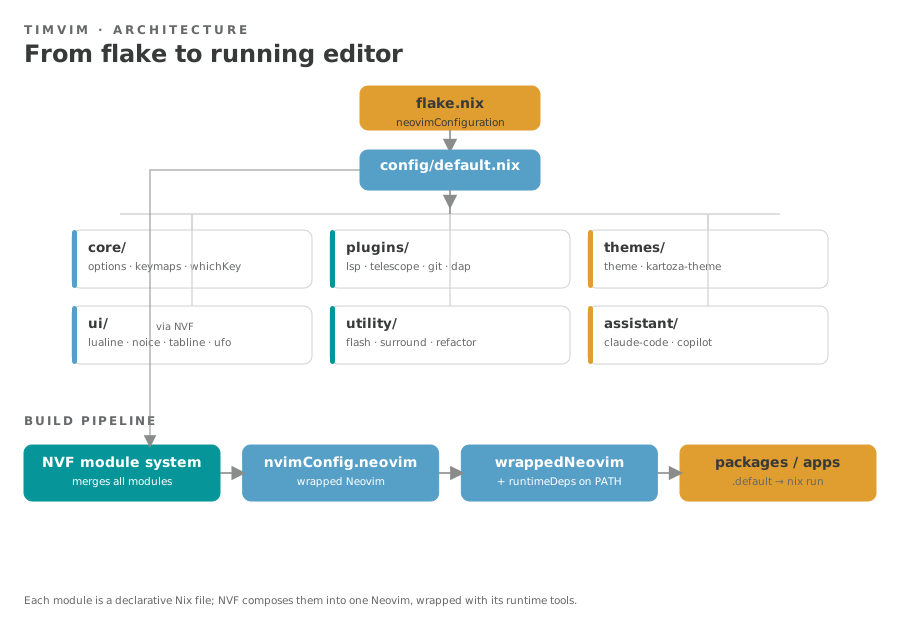
What lives where
| Sub-tree | Responsibility |
|---|---|
core/ |
Editor fundamentals: options.nix, keymaps.nix, whichKey.nix, clipboard.nix, formatting.nix, autocmp.nix, session.nix, autosave.nix, luaLoader.nix. |
plugins/ |
The bulk of functionality: LSP, treesitter, telescope, fzf, git, the debugger, per-language support, the alpha dashboard, Trouble, and more. |
themes/ |
Colour scheme selection and the Kartoza brand theme (theme.nix, kartoza-theme.nix). |
ui/ |
Visual chrome: statusline (lualine), noice, tabline, barbecue, fold UI (ufo), direnv integration. |
utility/ |
Editing helpers: flash navigation, surround, refactoring, multi-cursors, smart splits, outline, preview. |
assistant/ |
AI tooling: Claude Code integration (claude-code.nix) and GitHub Copilot (copilot.nix). |
Choosing the right sub-tree
Put a change where a future contributor would look for it. A new language
server belongs in plugins/ (near lsp.nix / languages.nix); a
cosmetic statusline tweak belongs in ui/; an editing motion belongs in
utility/. When in doubt, follow the pattern of the file nearest in
purpose.
How modules compose
NVF merges every imported module into one big option set. Because it is the
Nix module system underneath, order does not matter and options are merged,
not overwritten — two files can both contribute to vim.keymaps and NVF
concatenates them. This is why keybindings can be defined close to the plugin
they belong to and surfaced centrally in core/whichKey.nix.
Merges, not overrides
Because everything merges, a duplicated or conflicting mapping does not error loudly — it silently produces two mappings or an ambiguous chord. This is exactly why keybinding changes go through the formal change process: a human reviews the before/after so nothing collides.
The wrapped Neovim and runtime dependencies
NVF produces nvimConfig.neovim, but many plugins shell out to external
tools (ripgrep for telescope, gopls for Go, node for Copilot, and so on).
The flake collects these in a runtimeDeps list and wraps Neovim so they are
always on PATH, regardless of what the user has installed:
runtimeDeps = [
  pkgs.ripgrep pkgs.fd pkgs.fzf pkgs.chafa pkgs.git
  pkgs.go pkgs.gopls pkgs.gotools pkgs.delve
  pkgs.harper
  pkgs.python3Packages.rstcheck pkgs.python3Packages.doc8
  pkgs.nodejs_22
];

wrappedNeovim = pkgs.symlinkJoin {
  name = "timvim-wrapped";
  paths = [ nvimConfig.neovim ] ++ runtimeDeps;
  buildInputs = [ pkgs.makeWrapper ];
  postBuild = ''
    wrapProgram $out/bin/nvim \
      --prefix PATH : ${pkgs.lib.makeBinPath runtimeDeps}
  '';
};
wrappedNeovim is what packages.default and apps.default expose, and what
homeModules.default installs. It also means these tools are part of the
build closure and get cached alongside the editor.
A missing runtime tool is a flake edit
If a plugin needs an external binary at runtime, add it to runtimeDeps
in flake.nix — do not rely on the user having it. That keeps timvim
self-contained and reproducible.
Where the flake exposes things
| Output | What it is |
|---|---|
packages.default |
The wrapped Neovim. |
apps.default |
nix run — launches the editor. |
apps.handbook / handbook-build / handbook-pdf |
The docs pipeline (see The Docs Pipeline). |
checks.{format-check,deadnix,statix} |
Quality gates (see Building & Testing). |
formatter |
nixfmt-rfc-style, driven by nix fmt. |
devShells.default |
The contributor toolbox (see Dev Shell). |
homeModules.default |
Home Manager integration installing the wrapped editor plus formatters. |