The task runner
lib/tasks.sh is the qgis-dev command. It is the single source of
behaviour behind three front-ends, so nothing can drift between how the
editor, a terminal, and CI build QGIS.
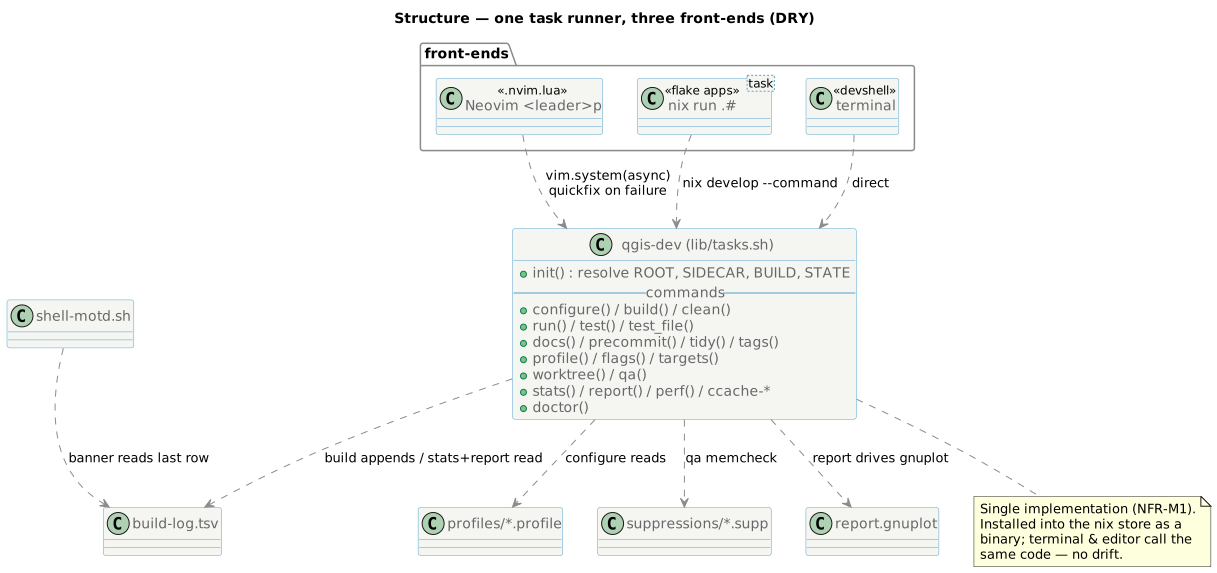
One implementation, three doors
- Neovim (
overlay/nvim.lua) maps<leader>p…tovim.systemcalls that runqgis-dev <cmd>asynchronously and parse failures into the quickfix list. nix run .#<cmd>enters the devshell and calls the same binary.- The terminal calls
qgis-devdirectly inside the devshell.
The flake installs tasks.sh into the nix store as qgis-dev
(install -Dm755), so the front-ends all execute identical bytes.
Anatomy of a call
init() resolves four locations from the current directory: ROOT (the
checkout, via git rev-parse), SIDECAR (from .dev-env/sidecar or the
.envrc symlink target), BUILD (ROOT/build) and STATE
(ROOT/.dev-env). Read-only commands that don't need a checkout — stats,
report, perf — deliberately skip init (it dies outside a checkout,
and die calls exit, which || true cannot catch).
Commands then compose smaller helpers: cmd_build snapshots ccache
counters around ninja and appends a row to the log; cmd_configure
sources the active profiles/*.profile fragment onto a CMAKE_ARGS array;
cmd_report runs an awk pass to produce clean data + summary scalars and
drives report.gnuplot.
Where behaviour lives
| Concern | File (read at runtime from SIDECAR) |
|---|---|
| Build presets | profiles/{debug,minimal,release,asan-ubsan}.profile |
| Valgrind noise filters | suppressions/{qt6,glib,python}.supp |
| Infographic template | lib/report.gnuplot (also exported as a store path) |
| Activation banner | lib/shell-motd.sh |
Because these are read live from the sidecar, editing a profile or the
banner takes effect immediately — no devshell rebuild. Editing tasks.sh
does need a reload, since it is baked into the qgis-dev binary; the
.envrc therefore watches it.