The flake
flake.nix is the spine. It pins the world, composes the devshell, and
exposes every task as a runnable app.
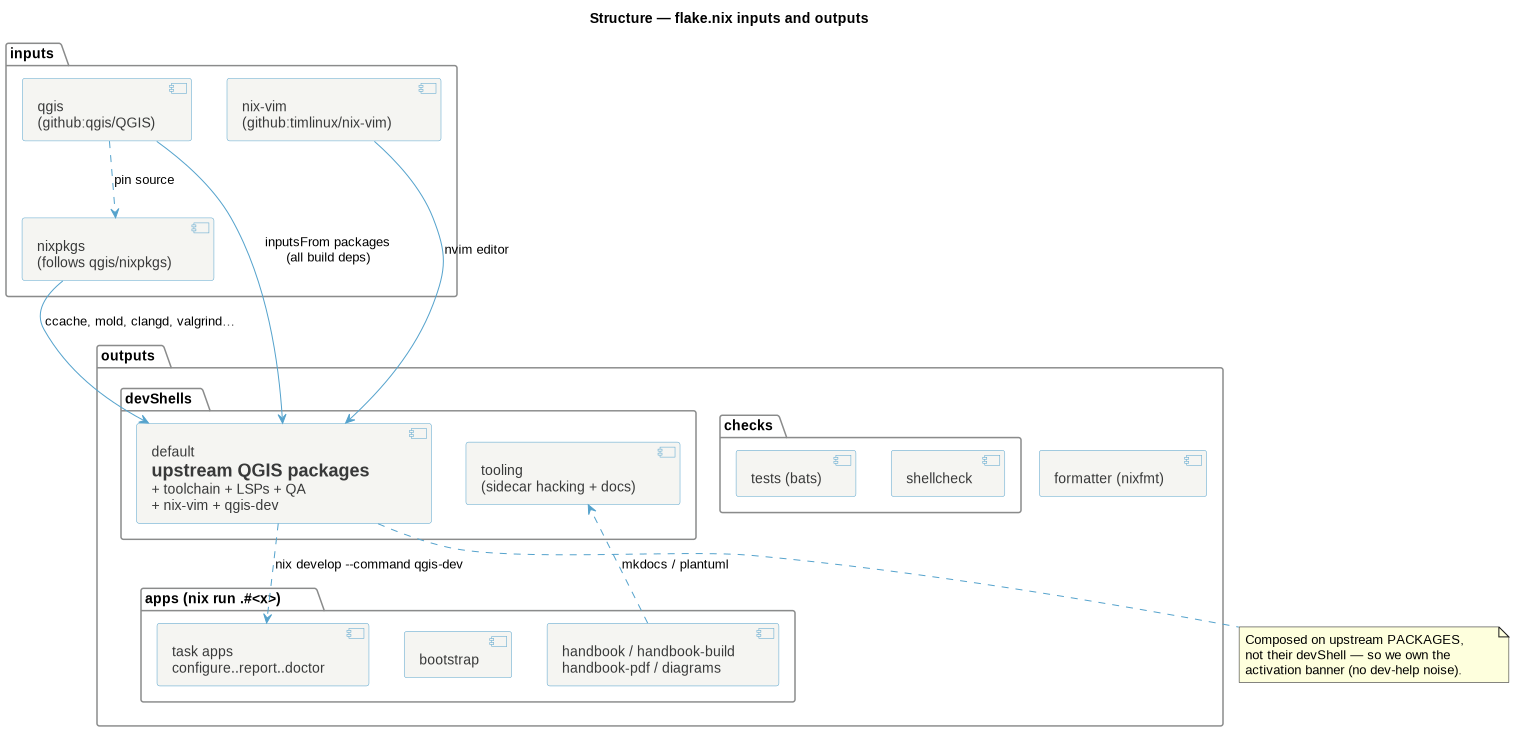
Inputs
| Input | Role |
|---|---|
qgis (github:qgis/QGIS) |
Upstream's own flake — we consume its packages, which carry the complete QGIS dependency set |
nixpkgs |
follows the QGIS input's nixpkgs, so our extra tools match upstream's library versions |
nix-vim (github:timlinux/nix-vim) |
The standard team editor, pinned independently so it behaves as released |
clang-tools-pin (nixpkgs-unstable) |
clang-format / clang-tidy at the QGIS-pinned major (v21); the toolchain nixpkgs only carries LLVM 19, and formatting must match CI (FR-Q4) |
Because inputs are content-addressed and locked in flake.lock, every
colleague resolves the identical toolchain by default — and this default
(the github pin) is what CI, a standalone clone, and devShells.tooling
always evaluate. It's deliberately not declared as a local path: a
relative path input that crosses outside this repo's own git tree hits a
real Nix bug on some versions — nix flake lock/nix flake check fail
with error: 'flake.nix' is too short to be a valid store path,
regardless of whether the input is spelled as a path:.. url string, a
Nix path literal, or an attrs-form string. Every spelling goes through
the same buggy resolution code once the input actually gets locked or
fetched.
Local embedded tracking (SRS C2, FR-N1) — so the devshell always matches
whatever QGIS revision you actually have checked out, not this pin —
happens entirely at invocation time instead, via
--override-input qgis "git+file://<absolute qgis root>" --impure.
git+file:, not a bare path:: upstream's own flake.nix selects its
source via lib.fileset.gitTracked, which refuses a plain directory
copy outright and wants a git-fetched source — exactly what git+file:
gives it (the same kind of fetch the github: pin above already
succeeds with). --impure is also what lets this fetch an
actively-edited (uncommitted) checkout, not just a clean one. .envrc
and the qgis-dev/nix run .#<task> app wrappers both supply this
(resolved from the real checkout path, never a relative one), so it never
touches the committed flake.lock and never hits the bug above. See
Activation & the devshell for where this is wired up.
devShells
devShells.default is composed with inputsFrom = [ qgis.packages…qgis
qgis…unwrapped ] — i.e. upstream's packages, not their devShell. That
distinction matters: pulling their devShell would inherit their
dev-help banner and shell hook; pulling their packages gives us the
exact same dependency closure while we own the activation experience (our
Kartoza banner). On top we add ccache, mold-wrapped, clangd, the LSP
servers, the QA tools, nix-vim and the qgis-dev binary.
devShells.tooling is the lighter shell for hacking on the sidecar itself:
mkdocs, plantuml, shellcheck, bats, gitleaks, reuse, nixfmt, stylua.
apps
Every task is also nix run .#<task> (configure, build, run,
test, report, doctor, …) — each is a one-liner that enters the
devshell and calls qgis-dev. Plus bootstrap, the docs apps
(handbook, handbook-build, handbook-pdf) and diagrams. This is what
gives terminal / editor / CI the same capabilities (FR-N4).
The task apps' generated script is where the local-checkout override from
the Inputs section above actually happens: it resolves the QGIS root from
git rev-parse --show-toplevel (the same technique qgis-dev's own
init() uses) and runs its inner nix develop --impure --override-input
qgis "git+file://$qgis_root" … — invisibly, so the outer nix run
.#<task> itself needs no extra flags.
checks & formatter
nix flake check builds checks.tests (the bats suite, shebang-patched
for the sandbox) and checks.shellcheck. formatter is nixfmt. CI runs
exactly these against the plain github-pinned qgis input — no QGIS
checkout required, since CI never applies the local override.
No code embedded in Nix
Per the project's rules, the flake never inlines shell or lua. It
references real dotfiles — lib/tasks.sh, lib/shell-motd.sh,
lib/report.gnuplot, overlay/* — and, where a runtime store path is
needed (the report template), exports it as an env var.